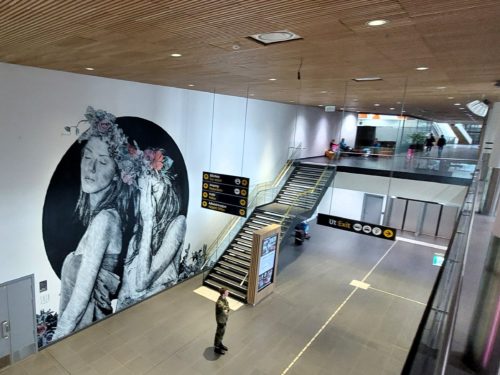
Pam McCarthy, Director of Aviation Strategy, discusses the opportunities and challenges that face aviation in 2026 and explains how commercial strategy can be leveraged to enhance the way airports are designed.
Return to Future ThinkingAviation in 2026: from risk to commercial opportunity

Contact Pam McCarthy, Director of Aviation Strategy
pam.mccarthy@benoy.com
What are the challenges and opportunities for aviation in 2026?
Trade tariffs and political unrest are factors to consider in the year ahead. With restrictions placed on certain flight paths, opportunities and challenges emerge. On the one hand, high-value, high-income routes will always need to be serviced, and in our global market, it’s merely a case of by whom, but on the other hand, the mass redistribution of foot passengers and restrictions on air traffic mean that these routes are being serviced by new airports and, at times, providers. For example, sanctions in one country more often than not result in another route or option opening up and benefitting. The question is: does the aviation market know how to use restrictions to its advantage? If it does, then it’s turning the risk into a commercial opportunity.
As always, servicing passengers, staff and the greater airport community better will be a key opportunity. Ultimately, we want to create a seamless experience for passengers, from the first physical or digital interaction. Traditionally, this has been from kerbside to boarding, which means finding the right design, backed by robust commercial insights. We’d like passengers processed quickly through the airport so they feel unhurried and then we want to have the right products in the right place before them so they can make purchases marked at the right price point for them. This information is gleaned from analysis linked back to passenger spend and purchase behaviour, also known as data design. Where there is strong data design, we can make sure everything is working together to enhance the passenger journey, while delivering optimised revenue potential for the airport.
Another big opportunity for commercial strategy is the advancement in technology, as it is for every industry year on year. We now have the ability to tailor details at a granular level, which is incredibly exciting. We can use technology to design something truly unique in a timely manner, further tailoring experiences.
How can commercial strategy be leveraged to enhance design?
When commercial strategy and architecture work together, we strengthen the whole offer as we design through the eyes of the passenger. Ultimately, we design for economic resilience. When a commercial agreement is up on a shop in an airport and a new brand or operator looks to move in (say an F&B supplier), historically the unit would have been gutted, the materials disposed of, and then new materials fitted in line with a more standardised plan. With the addition of commercial strategy, we can instead find ways to integrate the new tenant’s business into the existing space. Of course, when we are involved in the design at an early stage, we can fully support to optimise the allocated proportion of back of house, waste and front of house, resulting in better space utilisation and efficiency.
We ask questions like, ‘could they repurpose the materials’ and, ‘can they reuse materials’? On average, a large airport will have a churn of anything between 15 – 40 units up for change in any one year (factoring in pop-ups). Now, think about the number of times this happens on a global level. As strategic advisors, we can step in to help from the early stages to build a circular economy and avoid a take-make-dispose model.
Another early intervention on the part of commercial strategy could be the inclusion of dark kitchens. These kitchens might be downstairs in the airport basement, and they will have the licence to produce branded food, for example, Burger King, Wagamama, many establishments, but the kitchens themselves won’t be branded therefore making better use of the space in the airport. This small strategic change makes a huge commercial and economic difference and can be considered in existing infrastructure where there are services. It’s now a given in greenfield sites or masterplans.
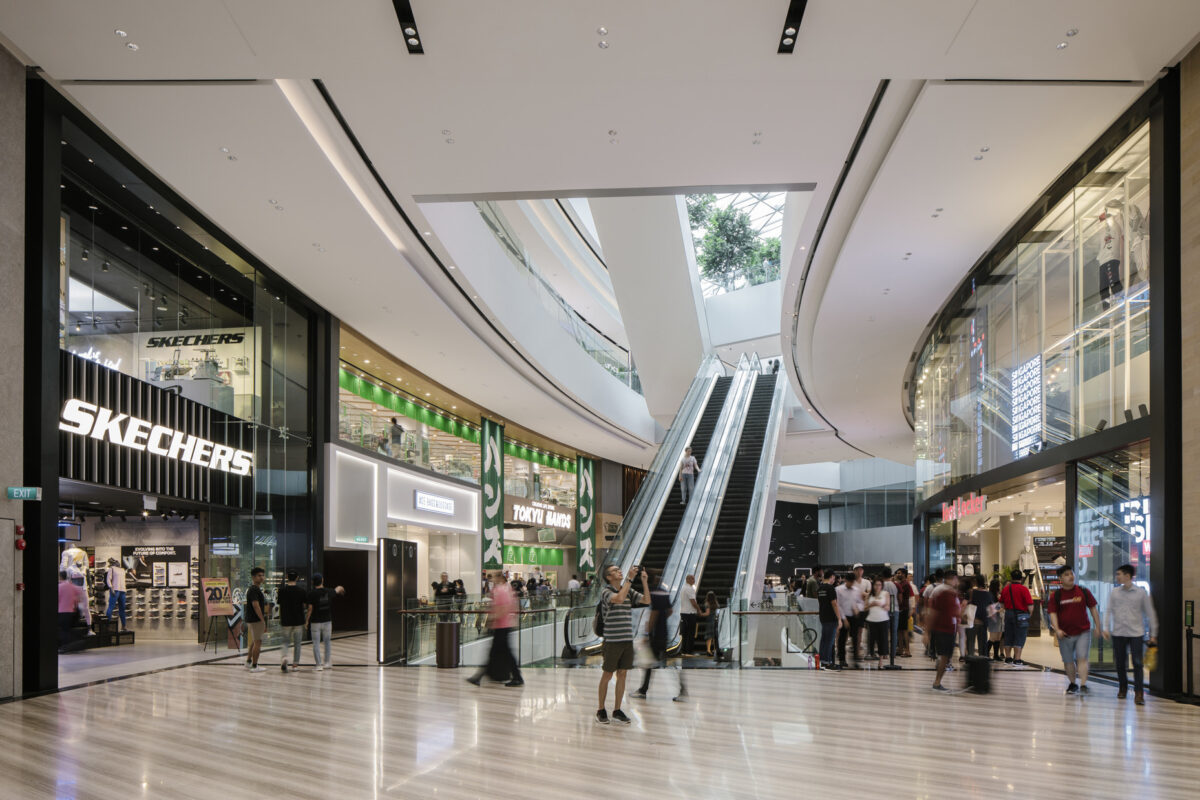
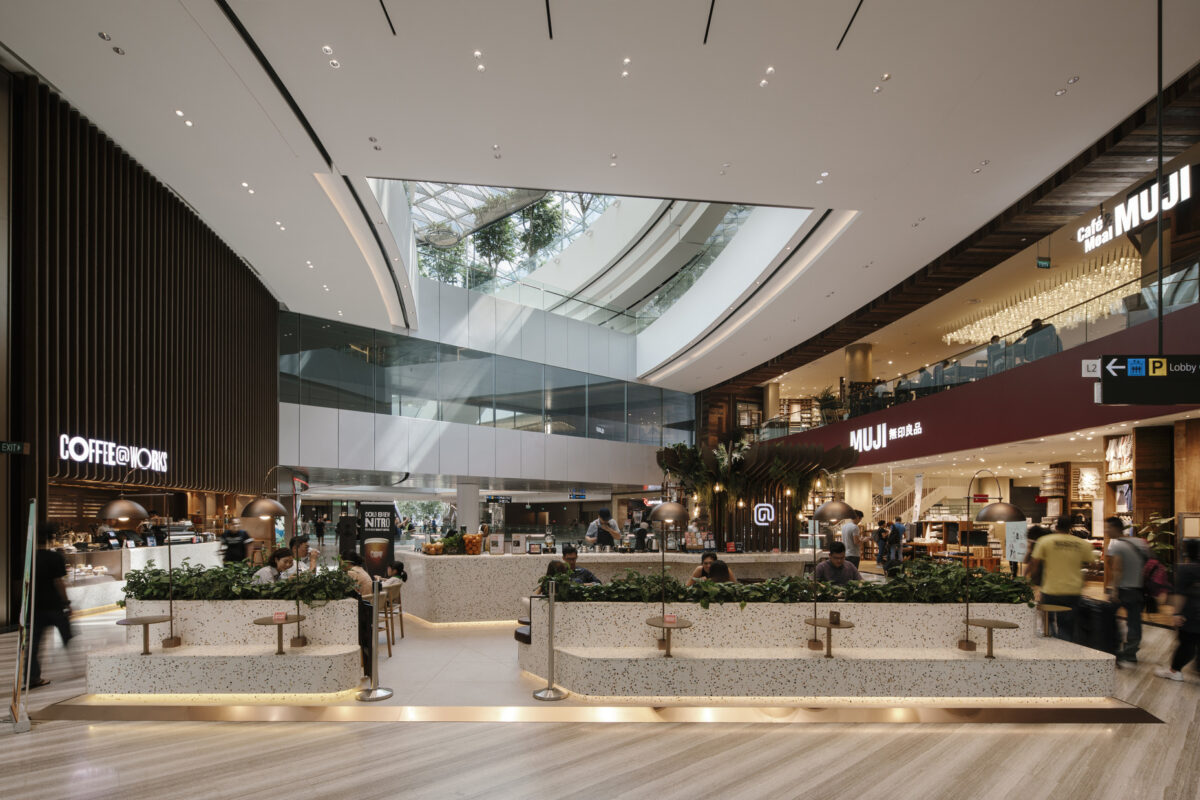
Jewel Changi Airport in Singapore, with interiors and retail planning by Benoy, is an excellent example of a time when the product was right for the customer. Our ambition was to extend the airport’s philosophy of reducing stress by creating calming, welcoming spaces. We produced detailed diagrams and business case studies to demonstrate how a retail-based environment could achieve this without overwhelming passengers. We also worked on a complex multi-storey elliptical plan and ensured that circulation and navigation remained clear and logical throughout. Combining design and strategy, we broke the plan up into clear zones and treated each section as a mini project within the bigger picture, each with its different demographics and functional requirements, with every zone catered for in line with the airport’s philosophy.
Passenger and staff experience, and client outcomes
Commercial strategy plays an integral role in working out what would make passengers and staff happy and therefore encourage them to spend more in an airport. We have focus groups with whomever we need to speak to: everyone landside, airport staff, and local residents are just some examples.
Aviation is not a one-size fits all industry. It varies widely by region. You may have a million passengers walking past your shopfront in a major airport in the UK, many of whom will have disposable income to purchase at your price point and therefore will consider whether or not to spend in store. In other parts of the world where there is greater disparity across passenger segments, of those one million people walking past your shopfront perhaps less than 5% have the disposable income to even consider a purchase in your store. Differences like these across regions and their airports prove the importance of working with a consulting firm like us who have global expertise and can tap into a well of knowledge. Using insights and analysis, you can tailor everything from canteen size to menu prices to be responsive to client and, by default, staff and passenger needs. Clients want to improve their bottom line at the end of the day and they want to be able to point to data to quantify improvements, and that’s where we add value.
Get in touch
For further discussion, please contact: Pam.McCarthy@benoy.com.

Related articles


19 November 2025