
- Author
- Angus Palmer
Angus, Director of Landscape Architecture, outlines how landscape-led infrastructure provides an alternative to hard engineering solutions offering not only function but enriching the character, ecology, and experience of a place.

When we view landscape purely as decoration or filling in residual space, we miss an enormous social, environmental and systematic opportunity to make a difference. We often think of infrastructure as the hard-working system that includes the roads, rail, power and utilities. This is, broadly speaking, understood to keep the city and everyday life running. Yet landscape infrastructure is equally fundamental. Through interconnected green, blue, social and climate-adaptive networks, landscape can support biodiversity, manage water, reduce heat, strengthen communities and improve everyday wellbeing.
Consider how landscape can operate as a localised layer of infrastructure. Landscape can shape how water moves, how places cool down and how cities adapt over time, offering us huge possibilities. Landscape shifts from being decorative to performative when it becomes the organising principle for urban and ecological form and delivers performance. What’s more, landscape architecture can sequester carbon, improve hydrology and remove greenhouse gas emissions at scale. Ecological systems form the discreet backbone of resilient, liveable cities and act as the foundational infrastructure.
The difference with landscape-led infrastructure is that landscape is placed at the heart of a design rather than at the end. The consequence of this is often that the land becomes functional and also an experience. Furthermore, when faced with hard engineering solutions that will shape a project, we as landscape architects should challenge conventional or ‘old school’ approaches and advocate for landscape-led infrastructure. Rather than accepting conservative, overly engineered outcomes such as exposed stormwater systems or roads that become visual eyesores, we can seek integrated solutions that allow infrastructure to perform functionally while also enriching the character, ecology and experience of the place. When we visit sites, the larger-scale sites tell us a story of what has happened there, what we need to respect and preserve, and where opportunity lies.

Three types of natural infrastructure which can be harnessed
Soft infrastructure
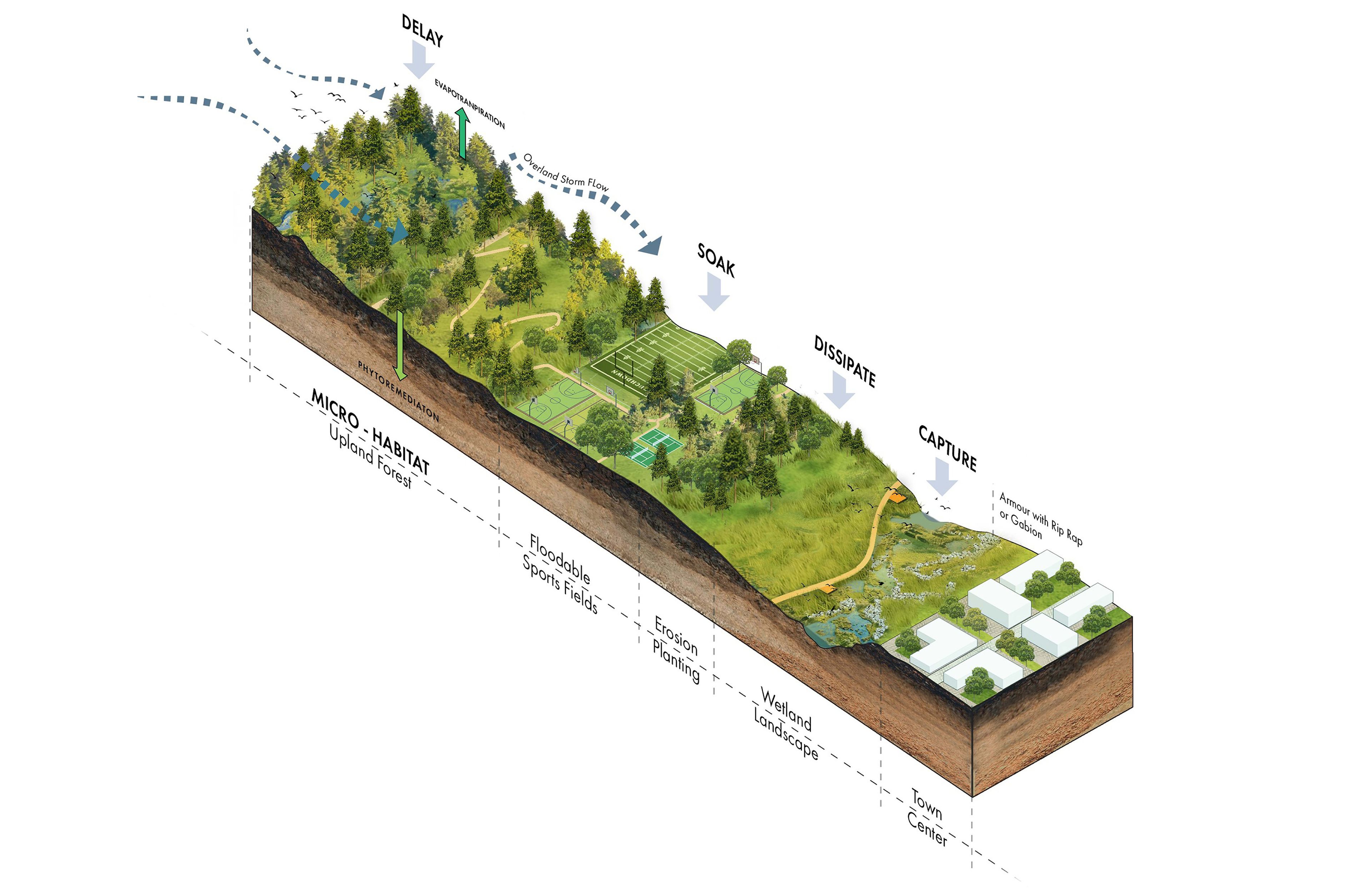
Soft infrastructure encompasses living systems at work. Natural elements like vegetation, soil and water cycles act as dynamic infrastructure and should be harnessed. We commonly replicate the hydrologic cycle by designing landscapes that slow, capture, filter, infiltrate and reuse rainwater, rather than rapidly conveying it away through pipes and drains. Through features such as wetlands, rain gardens, swales, permeable surfaces and restored waterways, these systems mimic natural processes while reducing flooding, recharging groundwater and supporting habitat. When we work with nature, not only do we provide a softer and more aesthetically pleasing solution, but we also provide an outcome that is also far more cost-effective than hard engineering solutions.
The Tbilisi project is a good example of how soft infrastructure can be harnessed effectively. The human-made lake – which is referred to as a sea – has a green, urban side and a more rugged side. The lake also provides the city’s drinking water, which posed some challenges when it came to surrounding developments. Tbilisi lies in a temperate, broadleaf and mixed forest biome. The project sits in a large, complex site in a transitional location given the Caucuses’ eco-region and subtropical continental climate. With 93% of the site being open space, we considered how to connect people by interrogating local sensibilities and habits when it came to hiking and being outdoors and included opportunities for agritourism and ecotourism.
Climate-adaptive infrastructure
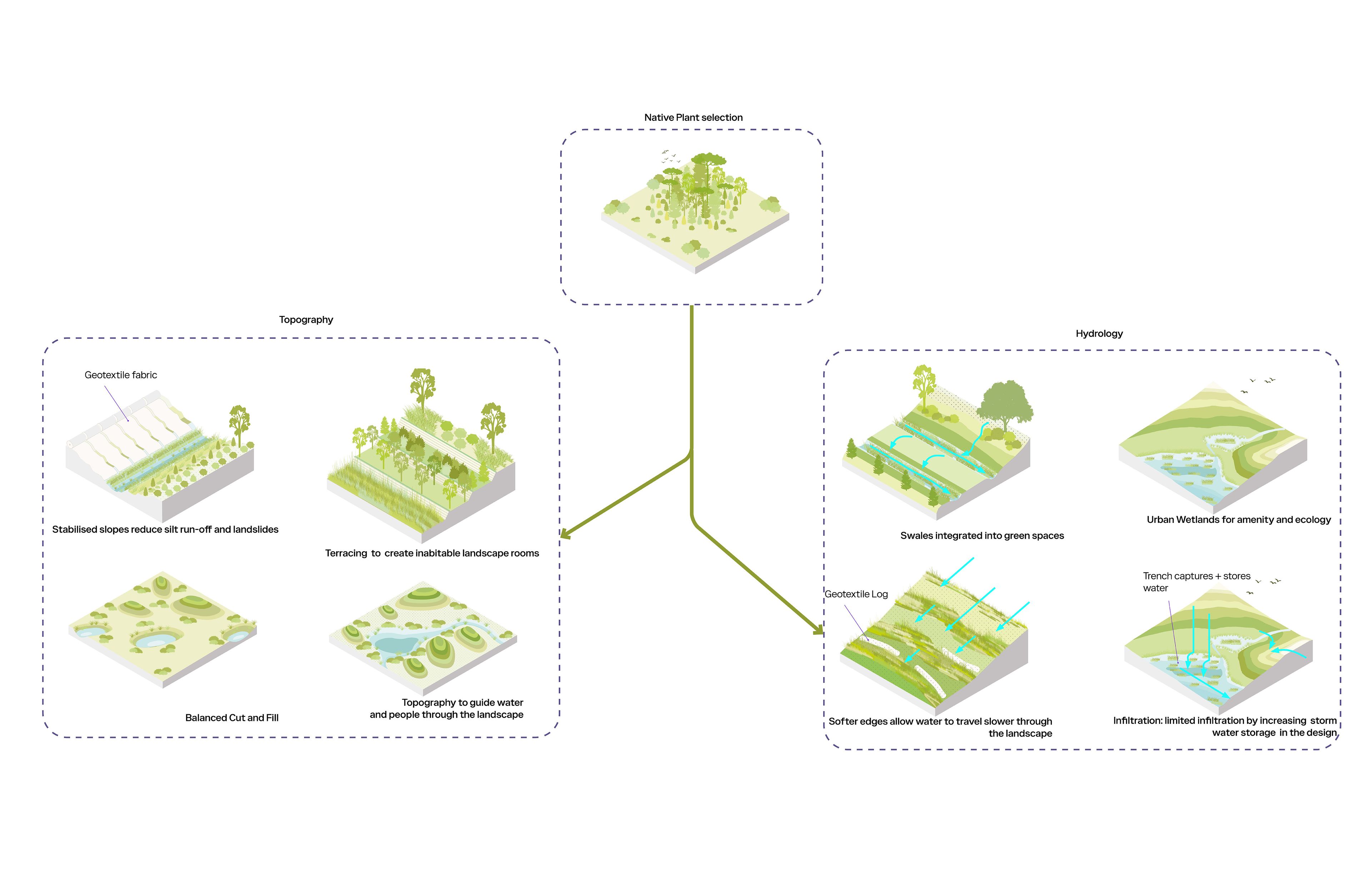
Restoring ecosystems can often bring untold benefits, and climate-adaptive infrastructure is a second way in which natural infrastructure can be harnessed. The aforementioned site in Tbilisi, Georgia, showed visible signs of erosion, with further evidence of silt accumulation compounded by the complex topography and eroded soil composition from flooding and hydrological conditions. It was critical we investigated means to restore these ecosystems. This project had considerable potential for landscape-led carbon drawdown interventions through ecological restoration and the integration of phytoremediation (which, in scientific terms, is the use of plants to absorb, stabilise or break down pollutants in soil and water). Combined with the creation of public space and habitat, these approaches could gradually remediate the site while also enhancing biodiversity, climate resilience and the overall experience of place.
The emerald blue of the Tbilisi lake is eye-catching and served as a good reminder of what would be lost if silt were to infiltrate the lake: silt starts to turn water muddy, blocking sunlight, lowering oxygen levels and possibly rendering the town drinking water unusable in time. If a site is being developed on a height and there is erosion present, then there could be a problem with silt being washed into the water. In order to protect the lake, we identified twelve different nature-based solutions for the site, some of which included constructed wetlands, Miyawaki forest planting, mass natural grass planting and infiltration trenches. These solutions solve some environmental problems and help to preserve ecology, thus reducing the need for hard engineering measures which impact the appearance of the site. We thought about planting strategies as we moved from the higher ground down to the lower ground near the lake to further help address erosion, aiming to restore aquatic and terrestrial ecosystems.
Landscapes as community connectors
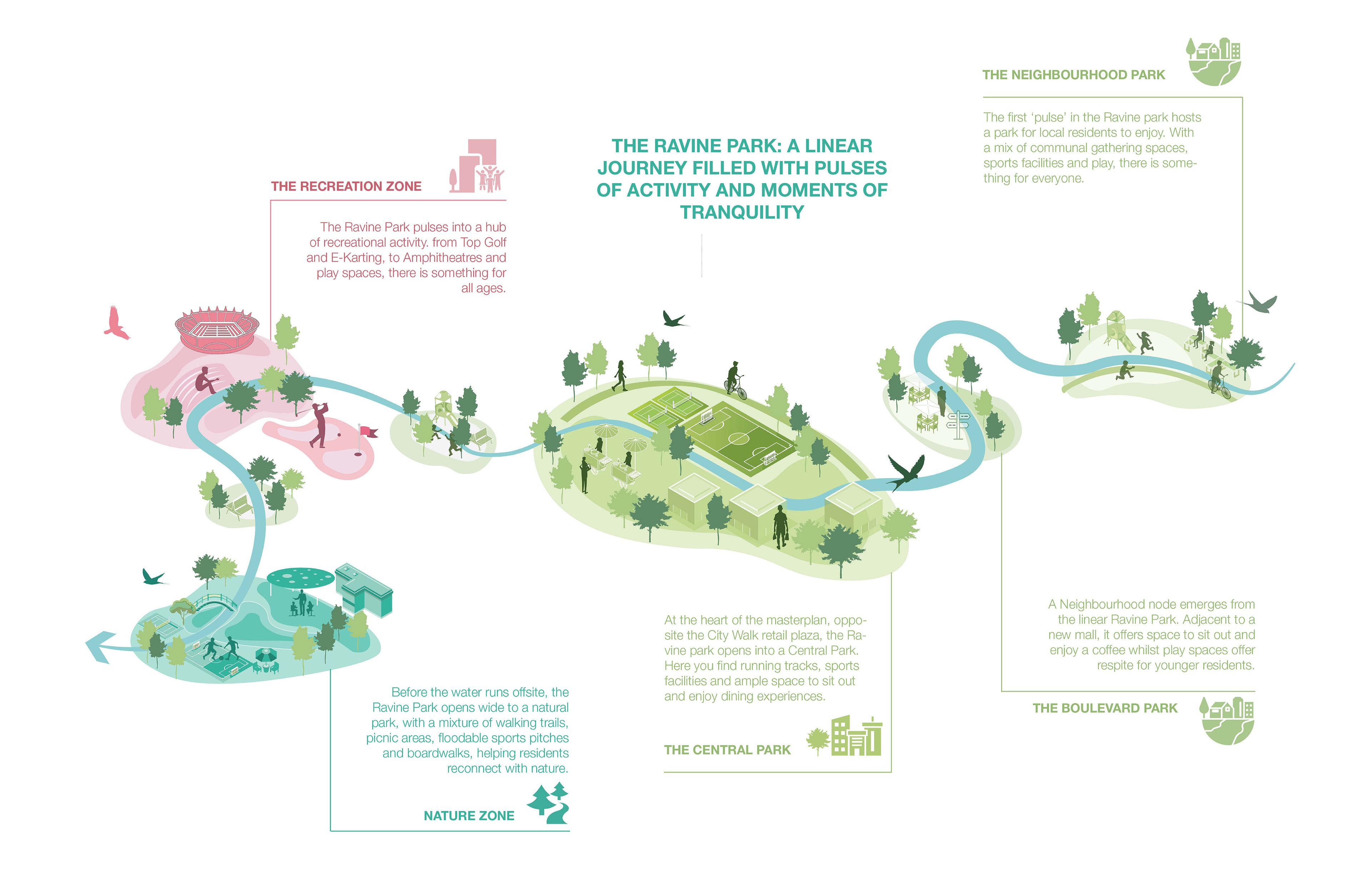
Social infrastructure encompasses the spaces and places that enable individuals to connect, build relationships and participate in community life, thereby improving overall quality of life. Equitable and convenient access to high-quality open spaces, such as parks, gardens, passive and formal recreational assets, play areas and civic landscapes, is essential to achieving this, ensuring that people of all ages and backgrounds can benefit from nature, recreation and social interaction close to where they live. These spaces can foster inclusion, support physical and mental wellbeing, and create a stronger sense of belonging and community.
Understanding human behaviour patterns and the context behind these spaces is key with social infrastructure. Landscape, after all, can be a framework for recreation and cultural identity, and augmenting the public realm (which is not always abundant in developing cities) brings multiple benefits. In a recent masterplan, we used the public realm as the site organiser. We created pocket parks, an adjacent water system, plazas and a district park, taking dust minimisation into account given the arid climate. We reduced roads as much as possible and were able to replace these spaces with boulevards, strengthening the public realm and making the area far more attractive.
A paradigm shift
Only by designing landscape infrastructure at a meaningful scale can ecological, social, and climatic outcomes be achieved. Advocating for city planning that positions nature as core infrastructure and integrates from project inception has numerous benefits, chief among them is that fact that nature keeps cities alive and liveable.